NEURAL MACHINE TRANSLATION: PROGRESS AND CHALLENGES
DOI:
https://doi.org/10.71465/csb129Keywords:
Neural Machine Translation, deep learning, Transformer models, Recurrent Neural Networks, language modeling, machine translation, data sparsity, computational complexity, bilingual dataAbstract
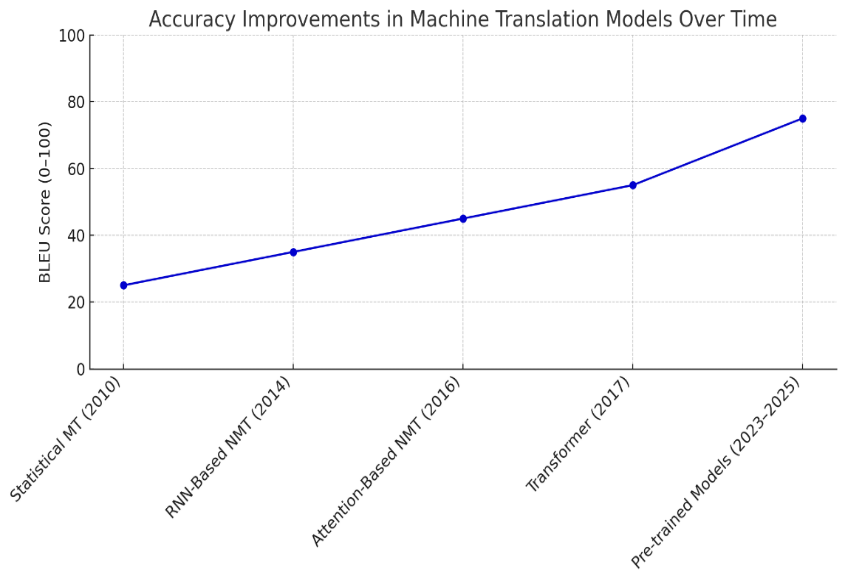
Neural Machine Translation (NMT) has revolutionized the field of machine translation, offering a new paradigm that leverages deep learning techniques to generate more accurate, fluent, and context-aware translations. Unlike traditional rule-based and statistical approaches, NMT relies on large-scale neural networks, particularly deep learning models like Recurrent Neural Networks (RNNs), Convolutional Neural Networks (CNNs), and Transformer models, to learn from vast amounts of bilingual data. This paper reviews the evolution of NMT, its advancements, and the significant challenges it faces, including issues of data sparsity, computational complexity, language diversity, and translation quality in real-world applications. We explore the key breakthroughs in NMT, discuss ongoing challenges, and provide insights into future research directions aimed at overcoming the limitations and improving the effectiveness of neural machine translation systems.
Downloads
Published
Issue
Section
License
Copyright (c) 2024 Computer Science Bulletin

This work is licensed under a Creative Commons Attribution 4.0 International License.
All articles published in the Computer Science Bulletin are distributed under an open access license, allowing unrestricted use, distribution, and reproduction in any medium, provided the original work is properly cited. Authors retain copyright and grant the journal the right of first publication. The journal encourages knowledge sharing while maintaining academic integrity and proper attribution.